
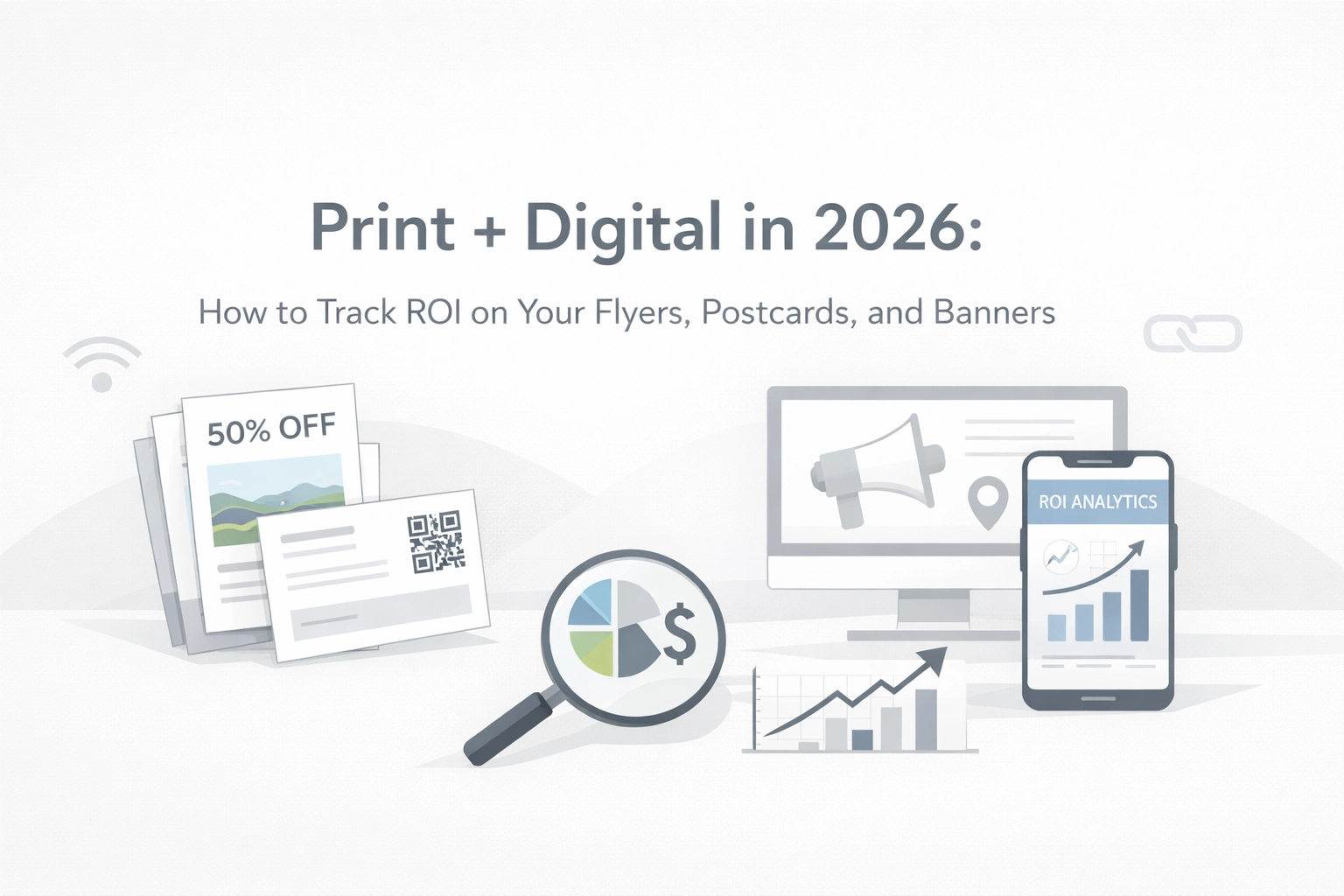
Let's cut through the noise: if you're still running print campaigns without measuring their performance, you're basically throwing money out the window. And if you think print is dead? The data says otherwise. In 2026, the smartest marketers aren't choosing between print and digital: they're combining them and tracking everything.
Here's what you need to know about measuring ROI on your physical marketing materials in today's connected world.
Why Integrated Campaigns Win
The numbers don't lie. Integrated print and digital campaigns deliver 40% higher engagement than digital-only efforts. That's not a small bump: that's a game-changer.
Think about it: your audience doesn't live in a single-channel world. They check their mailbox, scroll Instagram, Google your business, and make decisions based on multiple touchpoints. When you bridge print and digital, you're meeting them where they actually are.
The Metrics That Actually Matter
Forget vanity metrics. Here's what you should be tracking:
For Your Print Materials:
-
Response Rate – What percentage of people who received your flyer, postcard, or saw your banner actually took action? This is your baseline performance indicator.
-
Cost Per Response (CPR) – Divide your total campaign cost by the number of responses. If you spent $2,000 and got 100 responses, your CPR is $20.
-
Cost Per Acquisition (CPA) – How much did you spend to acquire each new customer? This tells you if your campaign is actually profitable.
-
Customer Lifetime Value (CLV) – The total revenue you expect from customers acquired through print. A $143 CPA looks expensive until you realize that customer will spend $2,000 over three years.
For Your Digital Components:
-
Click-Through Rate (CTR) – How many people clicked on your digital ads or landing pages after seeing your print materials?
-
Return on Ad Spend (ROAS) – For every dollar you spent, how many did you earn back?
-
Conversion Rate – What percentage of your digital traffic actually became customers?
For Integrated Campaigns:
-
Multi-Touch Attribution – Which combination of touchpoints (that postcard + the Facebook retarget + the Google search) led to the sale?
-
Lift from Integration – How much better did your integrated campaign perform compared to running each channel separately?

Tools and Methods for Tracking Everything
You can't manage what you can't measure. Here's your tracking toolkit:
CRM Platforms – HubSpot, Salesforce, or even a well-organized spreadsheet can help you track which customers came from which campaigns. Tag every lead source and watch the patterns emerge.
Google Analytics with UTM Parameters – Send people from your print materials to specific landing pages with unique URLs. Something like: colorflowprint.com/spring-sale?utm_source=postcard&utm_campaign=march2026
Call Tracking Numbers – Use different phone numbers on different print pieces. When someone calls the number from your flyer vs. your banner, you know exactly which one worked.
Promo Codes – Simple but effective. "Use code FLYER15 for 15% off" tells you exactly who responded to your flyer campaign.
Personalized URLs (PURLs) – Give each recipient or campaign a unique web address. When they visit ColorFlowPrint.com/YourName, you know who engaged.
Customer Surveys – Sometimes you just need to ask. "How did you hear about us?" remains one of the most valuable questions in marketing.
The Phygital Approach: Your Secret Weapon
The future of print isn't just print: it's "phygital." That's the combination of physical materials with digital tools, and it's crushing traditional campaigns.
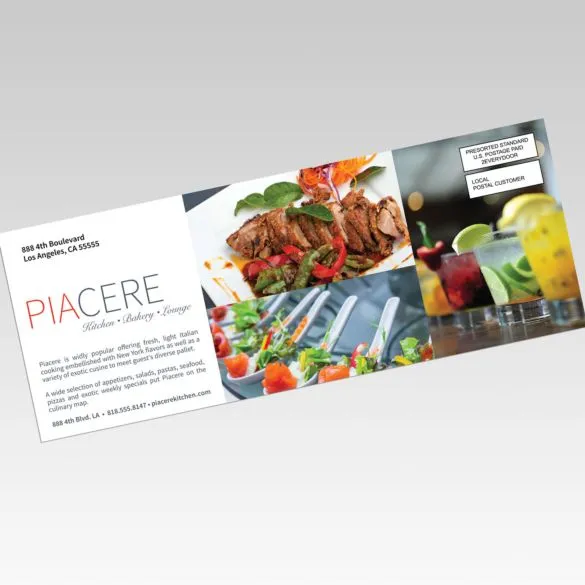
The simplest example? QR codes. Print a postcard, add a QR code, and suddenly your physical mail piece becomes a measurable, trackable digital gateway. Someone scans the code, lands on your website, and boom: you've got data on who engaged, when, and what they did next.

This isn't theoretical. Brands using QR codes on print materials are seeing significantly higher ROI because they're creating a seamless bridge between offline and online. Your grandmother might have ignored a QR code in 2016, but in 2026? Everyone knows how to use them.
Real Campaign Examples (With Real Numbers)
Let's look at what works in practice:
The HVAC Campaign:
- Direct mail to 10,000 households: $15,000
- Digital retargeting to those same households: $2,000
- Result: 119 new customers at $143 CPA
- Bonus: Built long-term brand awareness in the local market
The E-Commerce Catalog Play:
- Printed catalogs to top 500 customers: $5,000
- Result: Average order value jumped from $120 to $185
- Total revenue: $155,400 (compared to $100,000 from digital-only to a similar segment)
Notice something? The integrated approach won in both cases, but the ROI looked different depending on the business model. That's important.

How to Split Your Budget
Here's the formula that's working in 2026:
For Businesses with Physical Locations:
Split your budget 50/50 between print and digital. Your local presence matters, and print drives foot traffic better than any Facebook ad.
For E-Commerce Businesses:
Go 30% print, 70% digital. Use print strategically for high-value customer segments: like that catalog example above. Your best customers might respond better to something tangible in their hands.
For Service Businesses:
Start with 40% print, 60% digital, then adjust based on what your data shows. Test, measure, optimize, repeat.
The Bottom Line
Tracking ROI on print materials in 2026 isn't optional: it's essential. The good news? You've got more tools than ever to measure performance, and when you combine print with digital, you're not just tracking metrics: you're building campaigns that actually work.
Stop guessing. Start tracking. And watch your print campaigns deliver measurable, profitable results.
Ready to launch a trackable print campaign? At ColorFlow Printing & Graphics, we help New Jersey businesses create high-impact flyers, postcards, and banners designed for today's integrated marketing world. We'll work with you on designs that include QR codes, promo codes, and custom URLs: everything you need to track performance and maximize ROI. Contact us today to get started.