
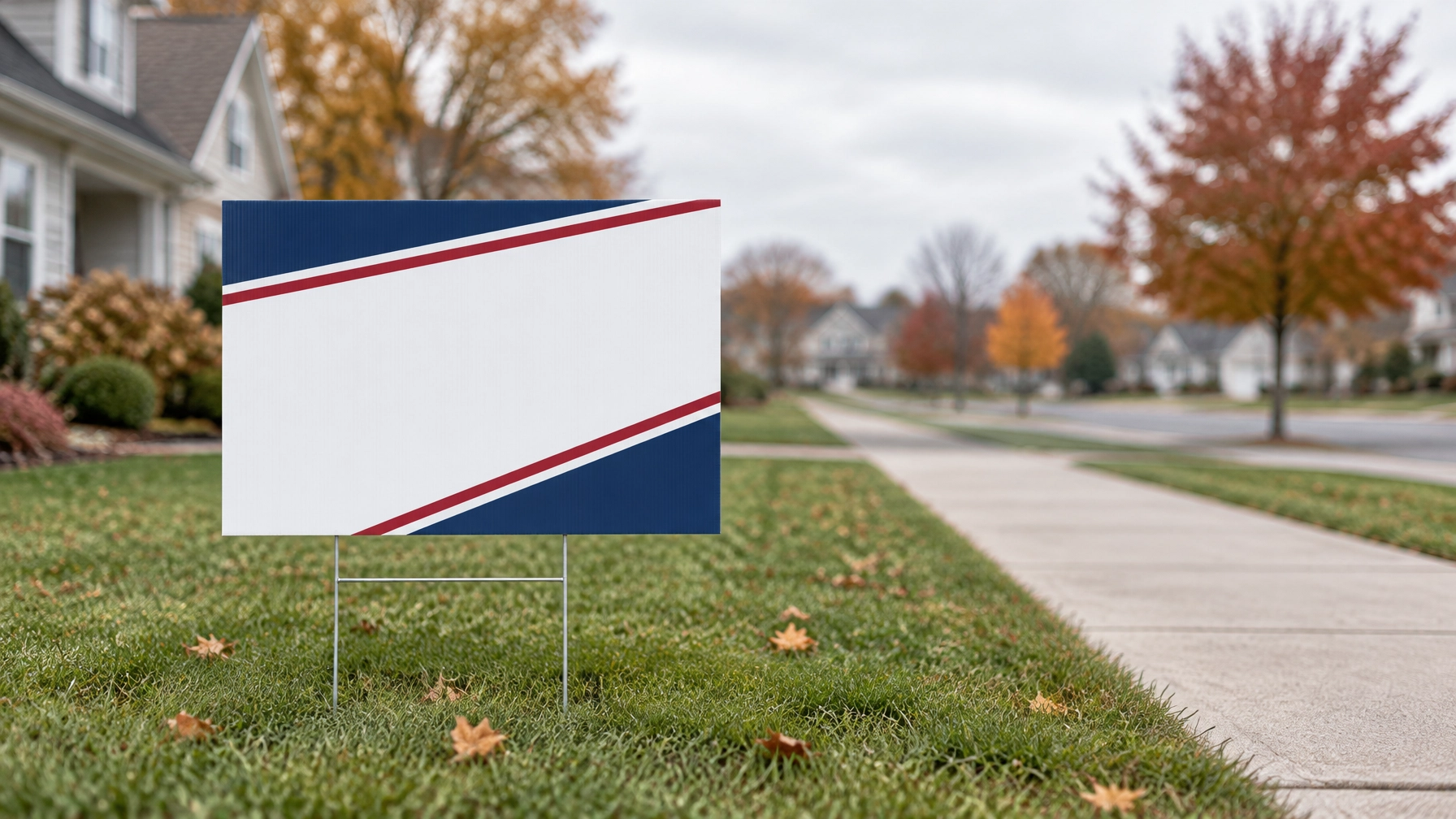
New Jersey’s general election is Tuesday, November 3, 2026. Early in-person voting runs October 24 through November 1. The official dates are listed in the New Jersey 2026 General Election timeline.
For campaigns, yard signs are a local visibility format. Their value depends on concise messaging, readable design, permissioned placement, accurate quantities, and timely removal. With Election Day approaching, production and placement decisions require immediate coordination.
Set the sign’s job before designing it
A yard sign has limited space. Assign it one primary purpose: identify a candidate, state a ballot position, or direct attention to an event or campaign resource.
Keep the message focused. Use the candidate or campaign name as the dominant element. Include a short identifier, such as the office sought, when needed for context. Avoid secondary slogans, long URLs, and small blocks of supporting copy.
Review sponsor identification and disclaimer requirements before sending artwork to print. Requirements may depend on the communication and campaign. Confirm the wording with campaign counsel or the appropriate election authority.
Design for a passing viewer

Yard signs are often viewed briefly and from a distance. Build the layout for immediate recognition.
- Use a strong contrast between the background and text.
- Choose a legible sans-serif typeface.
- Make the candidate name or central message the largest element.
- Limit the number of words and visual elements.
- Preserve clear space around text and logos.
- Keep required identification readable.
- Avoid fine lines, low-contrast colors, and decorative type that weakens legibility.
Review a full-size proof before approving the run. Check it at the expected viewing distance and in outdoor light. Test the design with people who have not seen it before. If they cannot identify the main message quickly, simplify the layout.
Confirm the finished dimensions, substrate, stake compatibility, and print specifications with the printer. These details affect artwork setup, installation, and handling. Do not assume that a file prepared for a flyer or banner is production-ready for a yard sign.
Confirm local rules and property permission
New Jersey sign requirements are not uniform across municipalities. Local ordinances may address sign size, quantity, setbacks, posting periods, removal deadlines, and placement on public property. Rules can also differ by property type and sign location.
Review the current code for every municipality in the placement plan. Start with the municipal code or zoning office. Examples of local rules are available in the Newark political sign ordinance and Oceanport sign regulations. These examples are not statewide standards.
Obtain permission from the property owner or an authorized representative before placing a sign. Record the property address, permission status, contact information, approved quantity, and removal plan. Confirm additional restrictions that may apply to a rental, condominium, or association property.
Do not treat a roadside area as available sign space. Confirm authority before placing signs on public land or within a public right-of-way. Keep signs clear of intersections, driveways, sidewalks, sight triangles, and locations that could obstruct traffic or maintenance.
If a local rule is unclear, ask the municipal zoning or code-enforcement office before installation. Do not rely on another town’s sign policy as a guide.
Calculate quantities from approved locations

Build the quantity estimate from the placement list, not a county-wide target. Count only properties where placement is permitted and approved.
A simple planning formula is:
Approved locations × signs allowed at each location + a limited replacement reserve = production quantity
Check municipal limits before applying the formula. Some ordinances set a per-lot limit; others regulate sign area, placement, or total display. A homeowner’s permission does not override applicable municipal requirements.
Create one master location log. Include the municipality, address, permission status, sign count, installation date, and removal responsibility. Assign one campaign contact to update the log and handle complaints or removal requests.
A small reserve can cover damaged or missing signs. Keep reserve inventory controlled. Additional signs should not be deployed unless the property and location are approved.
Set a realistic production and placement schedule
The November 3 election is days away, and early voting is already underway. Confirm printer availability, proofing time, production lead time, pickup or delivery, and installation staffing before finalizing a quantity.
Use this immediate sequence:
- Finalize campaign copy and confirm disclaimer language.
- Check local rules for every planned municipality.
- Secure property permissions and complete the location list.
- Approve a print proof and confirm materials and dimensions.
- Coordinate installation with the authorized placement window.
- Schedule inspections and post-election removal.
Do not assume that signs may be posted immediately or remain up for a fixed period. Each municipality’s rules determine the applicable window. The official New Jersey election FAQ provides election information, but it does not replace municipal sign-code review.
Early voting runs through November 1. Any voting-related message should remain accurate and consistent with official election information. Yard signs should not imply polling locations, dates, or procedures that have not been verified.
Coordinate sign placement with other campaign materials
Yard signs support recognition at a local level. They do not carry the detail available in brochures, flyers, mailers, or digital campaign communications. Use each format for a defined task, and keep names, colors, and key message elements consistent across the campaign.
Maintain a single approved artwork file and a record of the final production specifications. This reduces version errors across repeat orders and related materials. For additional visibility formats, review ColorFlow’s flag printing options.
Plan removal when planning installation
Every sign location should have a named removal lead. Add the applicable municipal deadline to the campaign calendar. Arrange retrieval promptly after the election or sooner if a local rule, property owner, or public authority requires it.
Track removed signs and report unresolved locations. Do not leave removal to an unassigned volunteer or assume that another campaign team will collect signs.
Campaign sign production with ColorFlow
ColorFlow Printing & Graphics provides professional printing for business and promotional materials. Campaigns can contact ColorFlow to discuss political campaign printing needs, confirm available formats, and review current production schedules.
For yard sign printing, provide the final artwork, intended quantity, preferred dimensions, placement timeline, and delivery requirements when requesting details. Availability and turnaround should be confirmed before campaign production is scheduled.